Darwin’s flints
Charles Darwin wrote On the Origin of Species at Down House, in Kent. He moved there with his family in 1842, aged thirty-three and often unwell, seventeen years before the book came out, and he lived there until his death in 1882. His son Francis grew up in the house and later described its days in close detail.
A day at Down House
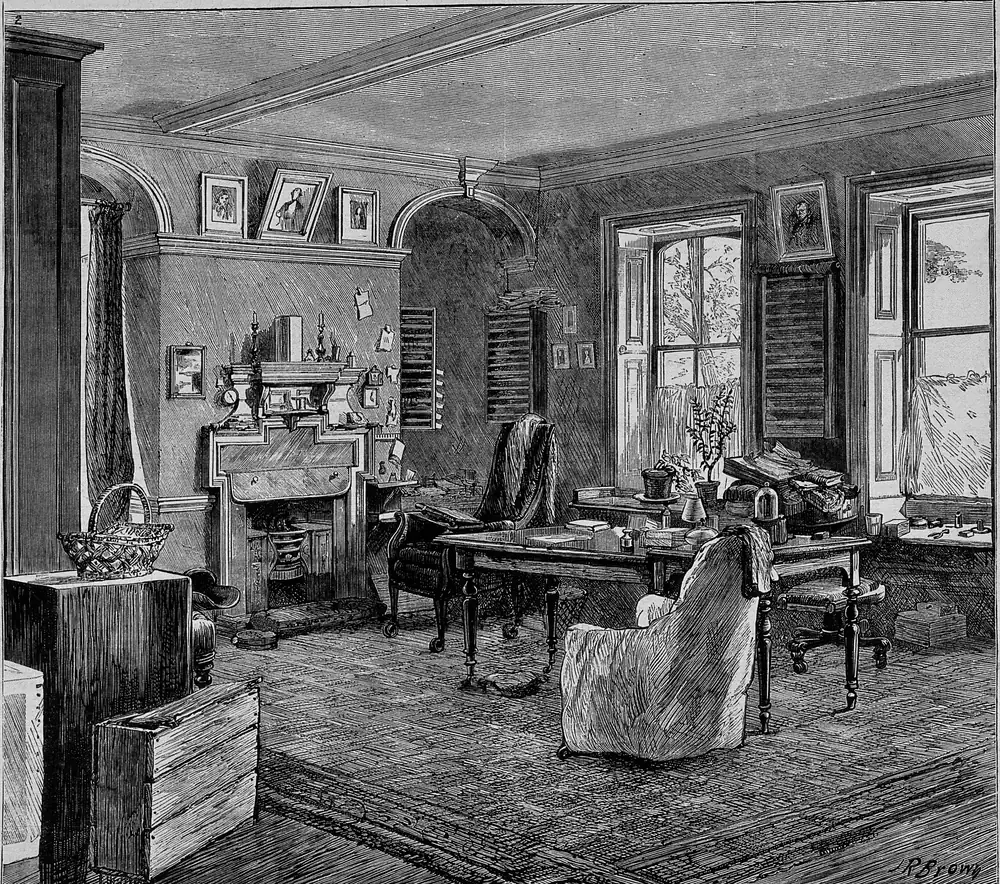
Darwin began with a short walk before breakfast, a habit he had picked up at a water-cure establishment and kept almost to the end of his life. He breakfasted alone at about a quarter to eight and went straight to work, and he regarded the hour and a half between eight and half past nine as one of his best working times of the day. At half past nine he came into the drawing room for his letters and to be read to; the reading included part of a novel. At half past ten he went back to his study until twelve or a quarter past, and that was the day’s work. Francis remembered him saying, “in a satisfied voice”, that he had done a good day’s work.
Then he went outside, “whether it was wet or fine”. After lunch came letters, and at about three he lay on the sofa in his bedroom, smoking a cigarette and listening to a novel. There was another walk, another short spell of work, and after dinner two games of backgammon with his wife, Emma, every night. He went to bed at about half past ten. “Week-days and Sundays passed by alike,” Francis wrote, “each with their stated intervals of work and rest.”
The Sandwalk
The daily walks followed a path Darwin had laid out himself in the grounds: about a quarter of a mile of stone and sand, known as the Sandwalk, or his thinking path. He walked it until the final weeks of his life. In his earlier years he went round a fixed number of times and kept count with stones. Francis describes it:
In earlier times he took a certain number of turns every day, and used to count them by means of a heap of flints, one of which he kicked out on the path each time he passed.
Working around his health
Darwin was ill for much of his adult life, with symptoms his doctors never managed to explain, and Francis adds a condition to the picture of an unchanging routine: “as long as he remained moderately well, there was no break in the regularity of his life.” The counting stopped in old age. “Of late years,” Francis wrote, “I think he did not keep to any fixed number of turns, but took as many as he felt strength for.”
Sources: Francis Darwin, “Reminiscences of my Father’s Everyday Life”, in The Life and Letters of Charles Darwin (1887), and his manuscript draft on Darwin Online. Darwin Correspondence Project. English Heritage, Down House history.