.jpg)
Hokusai’s lions
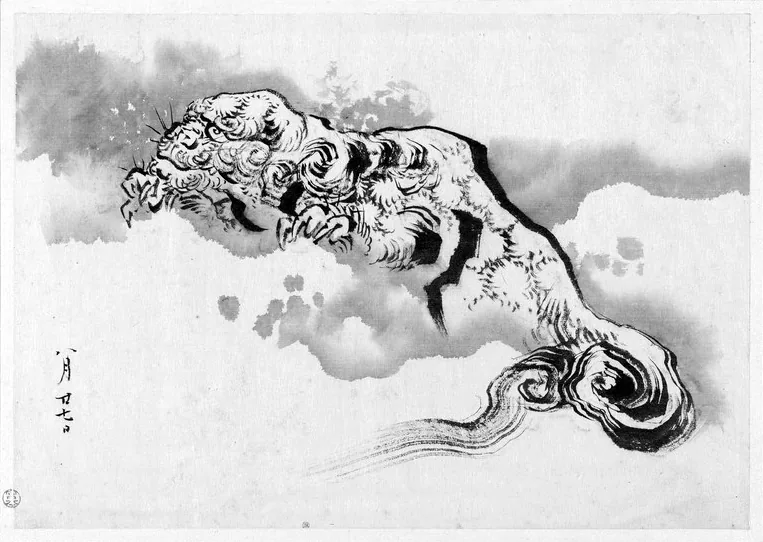
Katsushika Hokusai started his days in 1842 by drawing a lion, in ink, on a small sheet of paper. Nobody had ordered the lions and they were not for sale; he drew them for himself, as a charm. The name now given to them, nisshin joma, means roughly “driving out evil anew each day”. Hokusai was in his early eighties. He had made The Great Wave about a dozen years earlier, and had been famous for a good deal longer than that.
Debts, a grandson and a fire
They were difficult years. Hokusai was careless with money and ran up debts. He was repeatedly left to clean up after a badly behaved grandson, and for a while, for reasons that are still unclear, he lay low outside the city, in Urawa. Around the age of eighty he is said to have lost his house to fire, and most of his materials with it. He also moved house so often that people who wanted something from him had trouble finding him.
A lion every morning
The lions are quick drawings, done with what Japan’s national museums describe as “long, fluid brushstrokes”. The sheets carry the month and day they were drawn, and on some the date is worked into the picture. They vary a great deal. Lions leap through cloud and dance, and one clutches its head over an abacus. Some are given short lines of speech and behave like people.
The official description of the set, which Japan has designated an Important Cultural Property, notes that you can read the painter’s mood in them. One lion is soaked by rain, limp and dejected. Another throws out its chest and glares upward. One, dated the twenty-fifth day of the twelfth month, carries a line that the description says may safely be taken as Hokusai’s own: “Having thrown away desire, I am happy.”
The lions probably began as a kind of devotion. Some sheets carry a prayer that all sickness and misfortune be wiped out, and making a sacred image every day was an old practice in Japan. Tradition gives them a less solemn target as well: Hokusai is said to have meant them to drive off “the devil that is my grandson”. Ōkubo Jun’ichi, who supervised a 2022 exhibition of the set, thought that many were drawn with a viewer in mind, “as if Hokusai were grinning to himself: this is a fun idea, isn’t it?” Hokusai did not keep them. In a short preface he wrote for them later, he describes them as drawn every morning and thrown away.
How they survived
On one of his stays in the town of Obuse, in Shinano province, Hokusai was asked for a hanging scroll by Miyamoto Shinsuke, a retainer of the Matsushiro domain. In the words of the museum’s account, he “promised that he would paint the scroll and send it out before returning to Edo, but never got around to it.”
Shinsuke was later posted to his domain’s residence in Edo, and went looking for the artist. “Because Hokusai moved frequently,” it took him three years to find him, in Asakusa-tamachi in 1847. There was still no scroll. Instead, on the advice of his daughter Oei, who had been keeping the lions, Hokusai gave Shinsuke more than two hundred of them. He added a preface, a painting of a wish-granting jewel, and a sheet he titled “The Medicine for Longevity”.
The Miyamoto family kept them together. Today 219 sheets are at the Kyushu National Museum, and a few more are in Obuse and elsewhere. The official description says it is hard to find another case of one subject drawn so variously, and so continuously.
Hoping to live to a hundred and ten
In 1834, eight years before the lions, Hokusai closed his book One Hundred Views of Mount Fuji with a short postscript about his life. “From the age of six I had a habit of copying the shapes of things,” it begins, but nothing he drew before seventy was “really worth counting”. At seventy-three he had begun to understand a little of the bones of birds and beasts, insects and fish, and how grasses and trees grow. If he kept going, “at a hundred and ten, every dot and every stroke will seem alive.” He signed it with the name he now used: Gakyō Rōjin Manji, the old man mad about drawing.
He died in the spring of 1849, and his biographer Iijima Kyoshin, writing in 1893, recorded his last words. On his deathbed he sighed deeply and said, “If heaven would give me ten more years.” After a while he spoke again: “If heaven would give me just five more years, I could become a true painter.”
Sources: e-Museum, National Institutes for Cultural Heritage, Daily Sketches for Longevity and Exorcism. Cultural Heritage Online, Agency for Cultural Affairs, the official description of the set. Kyushu National Museum, collection page. Nishinippon Shimbun, report on the 2022 exhibition (30 April 2022). Shimane Art Museum, the postscript to One Hundred Views of Mount Fuji. Iijima Kyoshin, Katsushika Hokusai den (1893), as quoted by the Nishinippon Shimbun and Japanese Wikipedia. Translations from the Japanese are our own, except the e-Museum’s.