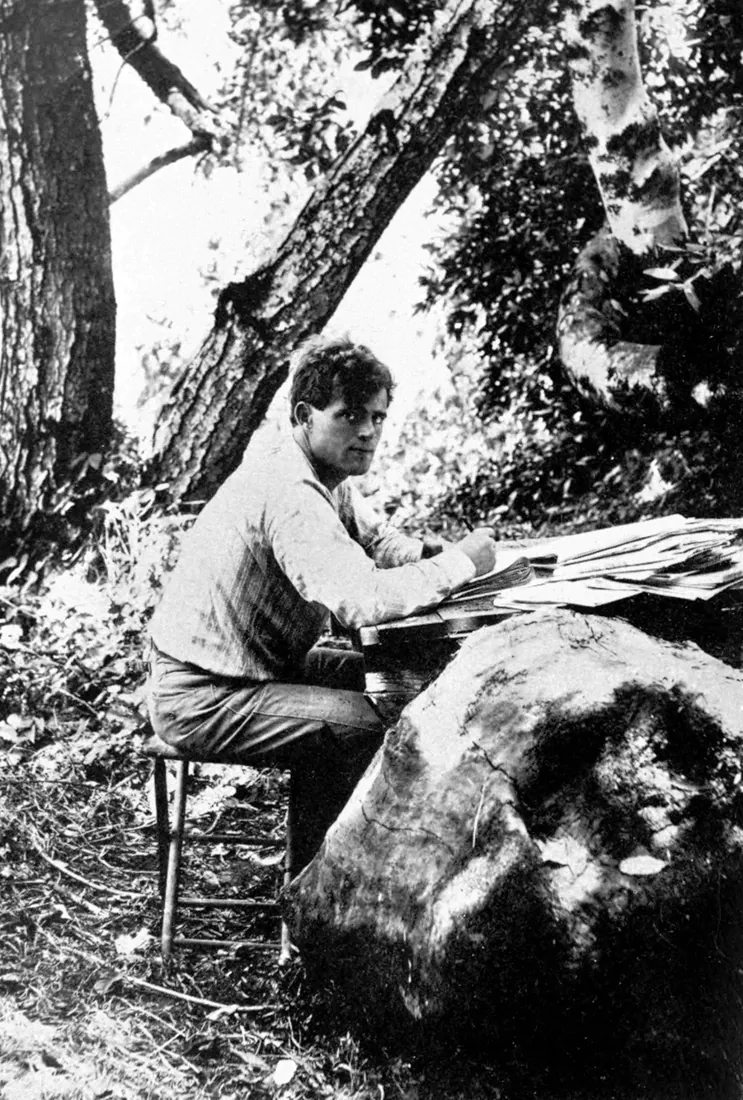

Jack London’s stint
Jack London called his daily quota of words his stint. He explained how it worked in a letter to his friend Cloudesley Johns in October 1899, when he was twenty-three and not yet known:
Am now doing a thousand words per day, six days per week. Last week I finished 1100 words ahead of the required amount. To-day (Tuesday), I am 172 ahead of my stint. I have made it a rule to make up next day what I fall behind; but when I run ahead, to not permit it to count on the following day.
“I am sure,” he went on, “a man can turn out more, and much better in the long run, working this way, than if he works by fits and starts.”
Fifteen hours a day, and nothing sold
Two years earlier he had worked the other way. In early 1897, short of money, he left university and decided to become a writer. “Heavens, how I wrote!” he remembered in John Barleycorn. “On occasion I composed steadily, day after day, for fifteen hours a day.” Then came a winter in the Klondike gold rush, and back in California he tried again. He wrote, by his own list, “short stories, articles, anecdotes, jokes, essays, sonnets, ballads, vilanelles, triolets, songs, light plays in iambic tetrameter, and heavy tragedies in blank verse”, and posted them all. “All my manuscripts came back.”
He had heard that magazines paid at least ten dollars a thousand words, and made his plans accordingly: “once I get started, I shall do no more than three thousand words a day, five days only in the week.” When a magazine at last accepted a four-thousand-word story, it offered him five dollars. “Five dollars! A dollar and a quarter a thousand!” He resolved to go back to shovelling coal, and was saved only when another magazine, the Black Cat, offered forty dollars for a story if he would let them cut it in half. He told them they could cut it “two-halves if they’d only send the money along”.
More words when he was broke
The thousand words a day date from this time, and when money ran short he raised the number. In January 1900 he wrote to Johns that he had pawned his bicycle (“my wheel”), bought stamps, and “jumped my stint to 1500 words per diem till I get out of the hole.” Eight days later: “Have not missed a day in which I have turned out at least 1500 words, and sometimes as high as 2000.”
By 1903, the year The Call of the Wild came out, he was giving advice to beginners in a magazine for writers:
Don’t loaf and invite inspiration; light out after it with a club, and if you don’t get it you will nonetheless get something that looks remarkably like it. Set yourself a “stint,” and see that you do that “stint” each day; you will have more words to your credit at the end of the year.
Mornings at the ranch
Once his books were selling, he wrote on every day of the week. “I confined myself to writing and typing a thousand words a day, including Sundays and holidays,” he wrote, on five and a half hours’ sleep. Years later, on his ranch in the Valley of the Moon, his mornings went like this:
Each morning, at eight-thirty, having been reading or correcting proofs in bed since four or five, I went to my desk. Odds and ends of correspondence and notes occupied me till nine, and at nine sharp, invariably, I began my writing. By eleven, sometimes a few minutes earlier or later, my thousand words were finished.
At half past eleven he was in a hammock under the trees with the mail-bag and the morning paper. In the afternoons he swam and rode.
He kept the stint at sea as well. On winter cruises around San Francisco Bay in his sloop, the Spray, he “took my machine along and did my thousand words a day”. On the Snark, the small boat in which he and his wife, Charmian, sailed the South Pacific, he caught malaria and doctored a sick crew: “I sweated out my thousand words a day, every day, except when the shock of fever smote me, or a couple of nasty squalls smote the Snark, in the morning.”
The thousand words and the first drink
John Barleycorn, published in 1913, is a book about his drinking, and the thousand words come up all through it. At the ranch he had one rule: “I never took a drink until my day’s work of writing a thousand words was done.” On days when he took a holiday from writing, he noted, “since it was no violation of my rule, I didn’t mind how early in the day I took that first drink.”
He also describes how the rule broke down. “I began to anticipate the completion of my daily thousand words by taking a drink when only five hundred words were written. It was not long until I prefaced the beginning of the thousand words with a drink.” For a while the words would not come without it. Then, “by truly heroic perseverance I finally forced myself to write the daily thousand words without the spur of John Barleycorn. But all the time I wrote I was keenly aware of the craving for a drink.”
Charmian London, in the biography she wrote after he died at the ranch in 1916, aged forty, said he kept up the thousand words a day for the rest of his life.
Sources: Charmian London, The Book of Jack London, vol. 1 (1921), via archive.org, for his letters to Cloudesley Johns. Jack London, “Getting into Print”, The Editor (March 1903), via Vintage Writing Instruction. Jack London, John Barleycorn (1913), via Project Gutenberg. Wikipedia, Jack London, for dates.