
Morrison’s coffee
When The Paris Review interviewed Toni Morrison in 1993, the year she won the Nobel Prize in Literature, its first question was about her habit of writing before dawn. Was it for practical reasons, or because the early morning suited her? Both, she said, and the practical reasons came first:
Writing before dawn began as a necessity—I had small children when I first began to write and I needed to use the time before they said, Mama—and that was always around five in the morning.
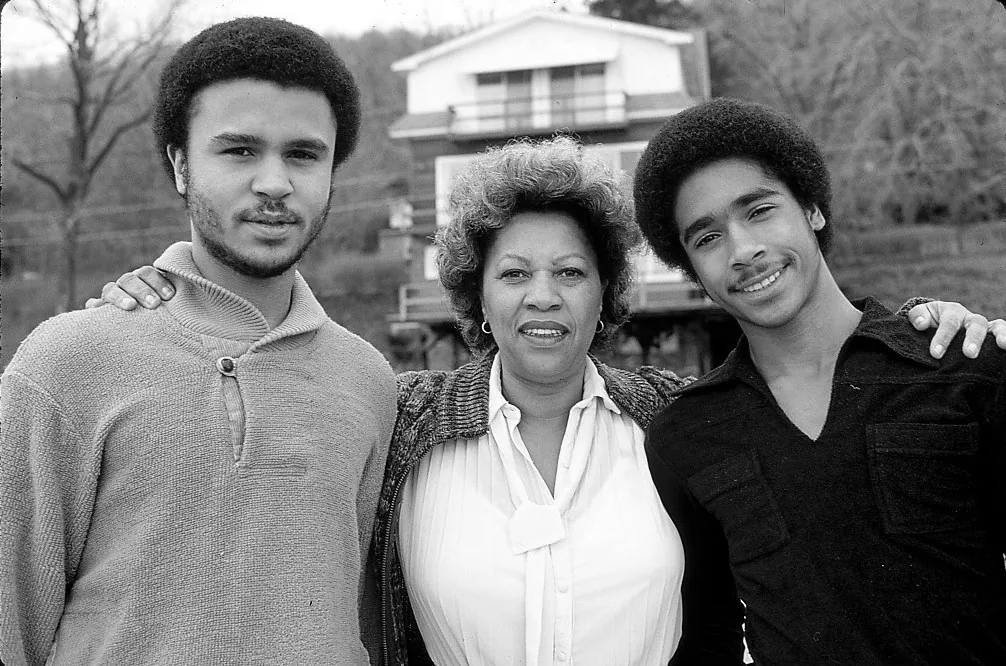
Two boys and a day job
She was born Chloe Wofford in Lorain, Ohio, in 1931, the second of four children in a working-class family. She studied at Howard and Cornell and went on to teach at Howard, where she joined an informal group of writers who met to discuss their work. To one meeting she brought a short story about a Black girl who longed for blue eyes.
In 1964 her marriage ended. “I decided to leave home,” she said, “to take my children with me, to go into publishing and see what I could do.” She took a job editing textbooks in Syracuse, New York, for a division of Random House, and two years later moved to the company’s offices in New York City. Meanwhile the story about the girl was becoming a novel. She was writing it for a simple reason: “I only wrote the first book because I thought it wasn’t there, and I wanted to read it when I got through.”
She told no one at work. “While I was at Random House I never said I was a writer.” None of the house’s editors published fiction of their own, and she thought she would have been fired. The Bluest Eye came out from Holt in 1970, the year she turned thirty-nine. Her colleagues, she said, “didn’t know until they read the review in The New York Times.”
Writing when she could
Asked about her working day, Morrison described an ideal she had “never experienced”: “nine uninterrupted days when I wouldn’t have to leave the house or take phone calls.” What she actually did was different:
I am not able to write regularly. I have never been able to do that—mostly because I have always had a nine-to-five job. I had to write either in between those hours, hurriedly, or spend a lot of weekend and predawn time.
Writing after work “was difficult.” Instead she tried “substituting compulsion for discipline”: when an idea was urgent enough, she “would move everything aside and write for sustained periods of time.” Sentences that came at other moments went down wherever she happened to be, “on scraps of paper, in hotels on hotel stationery, in automobiles.” For a while, driving to and from Random House every day, she tried speaking them into a tape recorder. “It was a disaster.” Everything she wrote for the first time went down in pencil, and she liked “yellow legal pads and a nice number two pencil”.
Early mornings by choice
In 1983 Morrison left Random House and spent a couple of years at home, working on Beloved. Without the office to organise her days, she found she hardly knew her own habits. “Work and the children had driven all of my habits . . . I didn’t know the weekday sounds of my own house; it all made me feel a little giddy.” One thing she did find out was that she was “clearer-headed, more confident and generally more intelligent in the morning.”
The habit of getting up early, which I had formed when the children were young, now became my choice. I am not very bright or very witty or very inventive after the sun goes down.
Talking with another writer about the small rituals people use to start work, she thought at first that she had none. Then she remembered: “I always get up and make a cup of coffee while it is still dark—it must be dark—and then I drink the coffee and watch the light come.” It was, she decided, her way into “a space that I can only call nonsecular.” “For me, light is the signal in the transition. It’s not being in the light, it’s being there before it arrives.”
Beloved was published in 1987 and won the Pulitzer Prize the following year. The Nobel came six years after that.
Giving it up at eighty-three
In 2014 Morrison spoke to the National Endowment for the Arts by telephone. By then she talked about the habit in the past tense:
I used to get up before sunrise. I’m very, very smart in the morning, and everything is clear. By noon it’s over. Then as the day wore on, I got dumber and dumber. That used to be my habit. I thought I did it because I had small children and I wanted to write before they got up. But then when they grew, I was still doing it and still preferring it. Not anymore because I’m too old. I’m 83, so some of those habits have changed.
Sources: Toni Morrison, “The Art of Fiction No. 134”, interviewed by Elissa Schappell with additional material from Claudia Brodsky Lacour, The Paris Review (1993). National Endowment for the Arts, “A Conversation with Toni Morrison” (2014). NobelPrize.org, Toni Morrison, biographical. Wikipedia, Toni Morrison, for the dates of her move into publishing.