.jpg)
Zola’s fireplace
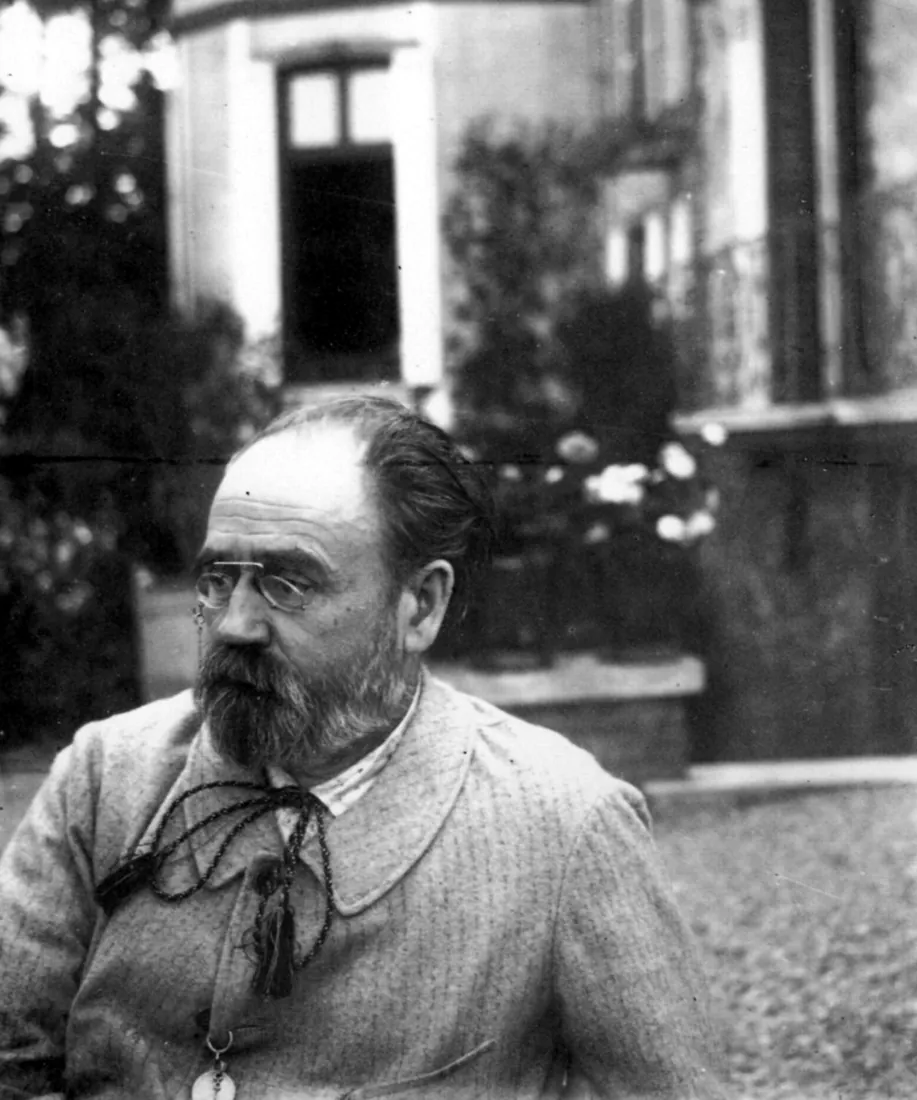
Émile Zola wrote most of his novels in a study at Médan, on the Seine between Poissy and Triel. He bought a small house there in the summer of 1878. Writing to Flaubert, he called it “a rabbit hutch” and told him the price, nine thousand francs, so that he would not be too impressed. That autumn he began building a square tower onto it, to his own design, with a study at the top. In February 1879 he paid 1,200 francs for a stone fireplace in the Renaissance style, carved with caryatids, and had four Latin words painted on its hood: Nulla dies sine linea. No day without a line.
Apelles and his daily line
The motto goes back to Apelles, a Greek painter of the fourth century BC. He was a favourite of Alexander the Great, who, according to Pliny the Elder, “would often come to his studio”. Pliny’s Natural History, written about four hundred years later, records the habit behind the motto:
It was a custom with Apelles, to which he most tenaciously adhered, never to let any day pass, however busy he might be, without exercising himself by tracing some outline or other; a practice which has now passed into a proverb.
Pliny also tells a story about a single line. Apelles sailed to Rhodes to meet the painter Protogenes, whom he knew only by reputation, and found him out. The old woman minding the studio asked whom she should say had called. “Here he is,” said Apelles, and with a brush he drew an outline “of a singularly minute fineness” across a blank panel on the easel. When Protogenes came home he knew at once who had been there, and he drew a finer line inside the first. Apelles came back and split both with a third, “leaving no possibility of anything finer being executed”. Protogenes conceded, and hurried down to the harbour to find his guest.
The panel was kept just as it was. Among other painters’ elaborate work, Pliny says, its three lines “had all the appearance of a blank space; and yet by that very fact it attracted the notice of every one”. It was lost in a fire at the imperial palace on the Palatine. Pliny describes the habit but doesn’t use the four Latin words, which came later.
Mornings at Médan
Zola’s mornings at Médan hardly varied. According to Ernest Vizetelly, his English translator, he rose at eight, walked for an hour, sat down at his table at nine and wrote until one. The journalist Robert Sherard has him climbing to his study “at nine, punctual to the minute”, after a breakfast of fried eggs. Friends had heard him scold the cook for getting the eggs wrong, “adding, ‘And the consequence is that my morning’s work was worth nothing.’”
Those morning pages came at the end of a long preparation. Before he wrote a word of a novel, Zola spent months on notes, a list of characters and “a most elaborate and detailed scenario”, so that, Sherard says, he had “actually written much more than the novel itself”. Pulling the plan together was the hard part, and it could not be done to a timetable. He described it to the Italian writer Edmondo De Amicis: “Two, three, or four days go by. One fine morning, in the end, whilst I am at breakfast and am thinking of something quite different, suddenly my two threads knot themselves together.” Only then did the daily stint begin:
And I set to work upon it quietly, methodically, with my watch in my hand. I write a little every day, three pages of print, not a line more, and I only work in the morning.
From that point, he said, he could “calculate infallibly the date when my book will be finished”. In June 1890 he wrote from Médan: “This morning, at last, I wrote the first four pages of ‘L’Argent.’ Now I have only to do the same amount of pages every morning for six or seven months.”
Five days a week, in his own words
His friends described the routine as unbroken. Paul Alexis wrote of “only four pages, but four pages every day, every day without exception, the action of the drop of water always falling on the same place, and in the end wearing out the hardest stone.” Sherard went further. Zola, he wrote, had never done more or less than his four pages, and laid down his pen the moment they were written, “no matter whether he may be in the midst of a sentence.”
A letter Zola wrote in June 1881 gives a different count. He was a few days into Pot-Bouille and pestering a friend with questions about stockbrokers’ clerks, civil service pensions and the houses beside the church of Saint-Roch. He also reported on his progress:
I progress with my usual slowness, three pages a day, and only five days’ work in each week, without counting unavoidable interruptions. It is the continuity of effort which makes big monuments.
Sherard, who printed the letter, called its last sentence “the axiom of Zola’s literary life”. He also noted that Zola had never taken much pleasure in the work: “It has always given him pain and anxiety.”
Goncourt’s visit
A few days before that letter, Edmond de Goncourt spent a day at Médan with the novelist Alphonse Daudet, the publisher Georges Charpentier and their wives. In his journal he called the property “mad, absurd, unreasonable”, and reckoned it had by then cost Zola more than 200,000 francs. The study, he allowed, was very fine, tall and spacious, but spoiled by “vile bric-a-brac”, in the middle of which “one reads on the fireplace the motto of Balzac: Nulla dies sine linea.” In a corner stood a harmonium, on which, Goncourt reported, the author of L’Assommoir played chords at nightfall.
The motto wasn’t Balzac’s. According to Vizetelly, Zola had adopted it early in life, and had it put over the fireplace “lest it should be forgotten”.
Twenty novels
The house at Médan is now a museum, and the fireplace is still in the study with the motto painted on it. Most of Zola’s books were written there. The Rougon-Macquart, the family saga of twenty novels that made his name, ended in 1893 with Le Docteur Pascal. Vizetelly did the sums: about twenty-five years’ work, twelve hundred characters, nine thousand pages of print and “quite two million five hundred thousand words”.
Sources: Pliny the Elder, Natural History, book 35, chapter 36, in the translation by John Bostock and H. T. Riley (1855), via Perseus, and the Latin text via LacusCurtius. Robert H. Sherard, Émile Zola: A Biographical and Critical Study (1893), via archive.org. Ernest Alfred Vizetelly, Émile Zola, Novelist and Reformer (1904), via Project Gutenberg. Les Cahiers naturalistes, the house at Médan, which quotes Zola’s letter to Flaubert and Goncourt’s Journal. Translations from the French are our own.